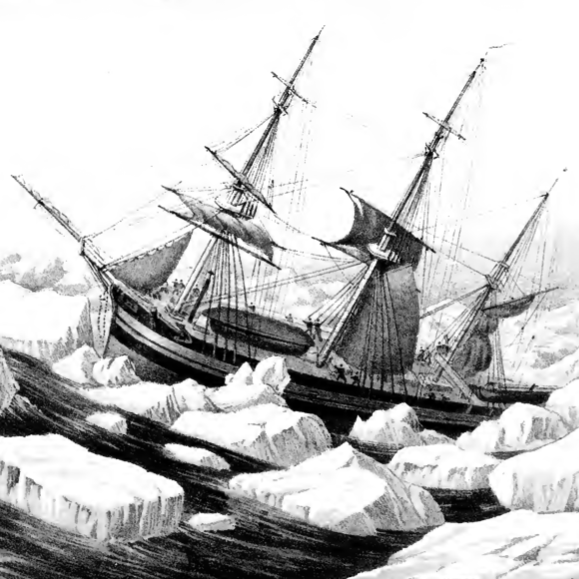
“Capt. Crozier wishes me particularly to tell you that all the botanical collections of the Terror were made by Lyall,” Joseph Dalton Hooker wrote to his father, the eminent botanist Sir William Jackson Hooker, in December 1842 from the Falkland Islands, where HM Ships Erebus and Terror were preparing for a third season in the Antarctic. “The latter often walks with me & though no Botanist, endeavours to make good collections, in which I am glad to hear you say he has succeeded.”
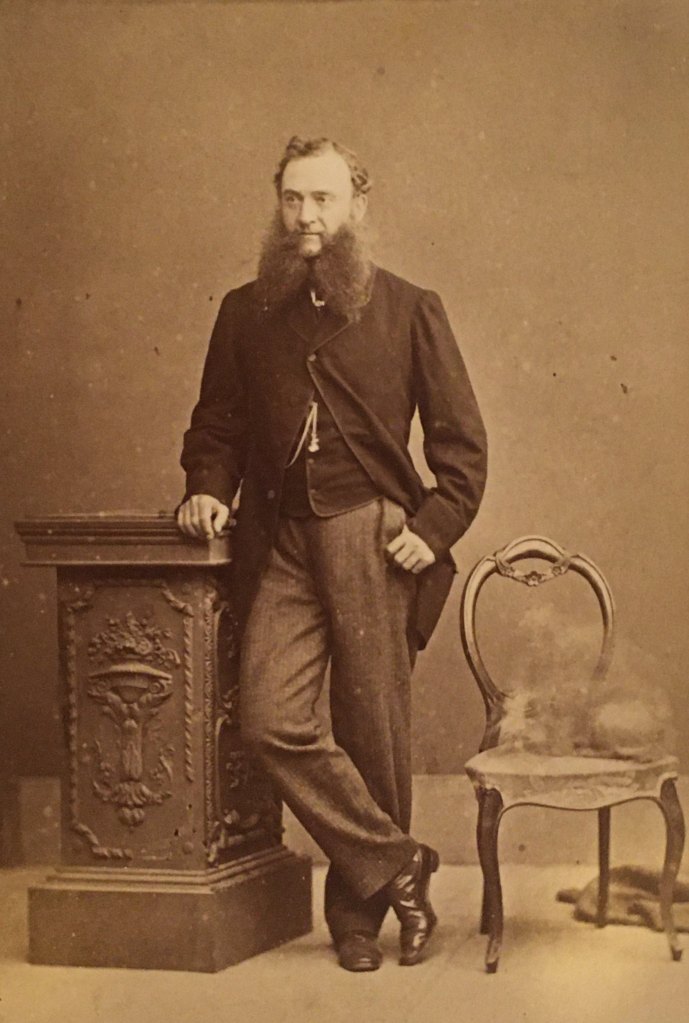
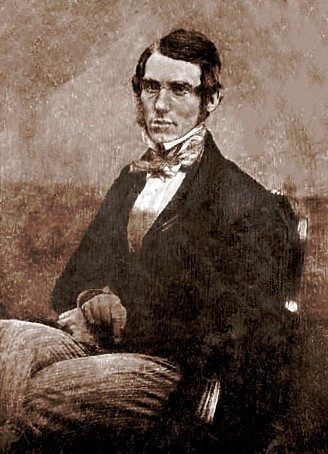
Hooker and Lyall, the assistant surgeons of the Erebus and the Terror, were two of the youngest officers on the expedition—both turned twenty-two in June 1839, a few months before the ships left England—and were serving in their first appointments in the Royal Navy. Hooker, who had settled for the assistant surgeon position after originally hoping for an appointment as the expedition’s naturalist, had begun attending his father’s lectures at Glasgow University at the age of seven, and saw the expedition as an opportunity to discover new plants in previously unexplored regions, as well as the first step in his own scientific career. Lyall had less of a scientific pedigree: the son of a Kincardineshire mill owner, he left an Arts course at Marischal College in Aberdeen in 1834 without taking a degree, and went on to obtain a surgeon’s license from the Royal College of Surgeons in Edinburgh four years later. According to Hooker, before joining the navy Lyall took a berth as a surgeon aboard a Greenland whaling ship, “as was not unfrequently the case with young Aberdonian medical men…to improve his medical knowledge, and throw himself early on his own resources”. If the whaling voyage gave Lyall a taste for the sea, it was the Antarctic expedition, and particularly his association with Hooker, that interested Lyall in botany. Writing up the first volume of his Flora Antarctica in 1844, Hooker praised “my zealous friend and co-operator, Dr. David Lyall,” and named an entire genus after him (Lyallia, a cushion plant endemic to the Kerguelen Islands). Later in the work, he noted that the herbarium Lyall collected over the course of the voyage contained 1,500 species.
The two surgeons’ professional paths diverged after the expedition returned to England in 1843. With the exception of a pair of sinecure appointments to provide him with an income while he worked to publish the expedition’s botanical findings, Hooker had little further involvement with the navy or use for his medical degree. He went on to a brilliant career as a botanist, developing a close friendship with Charles Darwin and succeeding his father as director of the Royal Botanical Gardens at Kew in 1865. After obtaining an M.D. from King’s College, Aberdeen, in 1844, Lyall continued as a naval surgeon, though he retained a keen interest in botany. Through Hooker’s father’s patronage, he was appointed surgeon on HMS Acheron‘s survey of the New Zealand coast from 1847 to 1851, giving him an opportunity to closely study the islands’ plants. After a stint in the Arctic aboard HMS Assistance with Edward Belcher’s ill-fated Franklin search expedition, he collected a wide-ranging herbarium while working on the North American Boundary Survey, which took him from the Pacific Ocean to the Rocky Mountains before he was invalided back to England in 1861 due to declining health. A lieutenant of the Royal Engineers who served with him on the Boundary Survey noted, “he has been on an Arctic expedition and on an Antarctic expedition and though not a very talkative man, we get curious yarns from him at times”.
Both Hookers continued to take an interest in Lyall after he returned to England. William Hooker arranged for a sinecure appointment to HMS Fisgard in 1862 to allow him to work on organizing and describing his North American collections at Kew; Lyall would pay tribute to the elder Hooker’s patronage by naming his second son, born in 1876, William Hooker Lyall. Joseph Hooker and Lyall remained friends and correspondents for the rest of their lives. In later years, their letters increasingly turned to news of former shipmates’ deaths; Hooker would later claim, inaccurately, that they were “the two last surviving officers of the Antarctic Expedition”.1 When Lyall died in 1895, aged 77, Hooker eulogized him in both the Royal Geographical Society’s journal and the Journal of Botany, British and Foreign, particularly praising his botanical work in New Zealand and the Arctic. Hooker lived for another sixteen years, long enough to offer advice to a new generation of Antarctic explorers, and died in December 1911, aged 94.
Sources
- Hooker, Joseph Dalton. Letter to Sir William Jackson Hooker. 5 December 1842. JDH/1/2 f.151-154. The Royal Botanic Gardens, Kew. https://jdhooker.kew.org/p/jdh/asset/1920
- ———. The Botany of the Antarctic Voyage of H.M. Discovery Ships Erebus and Terror in the Years 1839-1843 Under the Command of Captain Sir James Clark Ross. 3 vols. London: Reeve Brothers, 1847-60.
- ———. “David Lyall, M.D.” Journal of Botany, British and Foreign 33 (1895): 209-11.
- ———. “Dr. David Lyall.” The Geographical Journal 5, no. 6 (June 1895): 602-03.
- Huxley, Leonard. The Life and Letters of Sir Joseph Dalton Hooker. 2 vols. London: John Murray, 1918.
- Lyall, Andrew. “David Lyall (1817-1895): Botanical Explorer of Antarctica, New Zealand, the Arctic and North America”. The Linnean 26, No. 2 (2010): 23-48.
- Lyall, David. Letter to Joseph Dalton Hooker. 22 March 1877. JDH/2/1/5 f. 215. The Royal Botanic Gardens, Kew.
- ———. Letter to Joseph Dalton Hooker. 28 December 1877. JDH/2/1/5 f. 216. The Royal Botanic Gardens, Kew.
- Peter Scott, former mate on the Terror, was still alive when Hooker made this claim in 1895; he would die in March 1900, aged 83 or 84. It’s unclear whether Hooker was aware of this, as they don’t appear to have corresponded after the voyage. Or perhaps he thought that Scott, who was one of the officers left behind in Van Diemen’s Land to staff the magnetic observatory there, shouldn’t count as he hadn’t completed the whole voyage. ↩︎


Leave a comment